
The Hours, The Opera, and Me, Part Two: Margaret
Strident!

Last week, I said I’d publish this the day after my post about The Hours, unless I went to another workout class. You’ll never in a million billion years guess what happened. To be fair, I also went to a wedding, and congratulations to Jared and Patrick. But she’s here (me, sitting in the Lincoln Center plaza finishing this, and her, this piece), and she’s about Kenneth Lonergan’s Margaret (2011). I am this movie’s number one fan.
Part three is actually coming tomorrow, as it is most of the way written. If you’re not already, subscribe so you can read the thrilling conclusion of my saga of hyper fixations.
I decided to watch Margaret (2011) for the first time on January 7th, 2021. Was it for reasons to do with January 6th, 2021? Sure would sound poetic to say so! I don’t think it was, though. Sorry. It was more that I was on an Allison Janney filmography completist journey, and my work from home workweek ended on Wednesday. Also, I had been putting a lot of my work on January 6th off until the end of the day (as one does if they have to be logged on from 9a to 8p), and then I had to do a lot of scrambling when someone Slacked for us to log off at 4pm, while frantically messaging my manager like, “sorry sorry sorry just doing these follow up emails because I have my THREE DAY WEEKEND after this and my work isn’t done yet and not because I was watching MSNBC instead of doing it ha ha ha!” I was stressed! Naturally, I decided to watch Margaret, a notoriously non-stressful or distressing movie (and to the friends who have watched it because of me and told me it was good but they will never watch it again, you are welcome). I then realized I had watched the theatrical cut, not the extended cut, so I put on that cut immediately after watching the theatrical cut; if you’re following along at home, yes, I watched 5.5 straight hours of Margaret the first time I saw it. You must understand why I am the way I am now. If not, buckle up.
Explaining the plot of Margaret to someone who’s never seen it can be frustrating. At the beginning of Margaret, Lisa Cohen (Anna Paquin) wants to buy a cowboy hat on the Upper West Side, so she tries to flag down a bus driver (Mark Ruffalo) wearing one to ask where he got it; he takes his eyes off the road, runs a red light, and hits a woman crossing the street (Allison Janney), who dies in Lisa’s arms. Lisa lies in her police statement to say the light was green. Margaret unfolds from there. So it’s about a teen girl who causes a bus crash, but it’s also about her actor mother, Joan (J. Smith-Cameron), but it’s also about New York City, but it’s also about post 9/11 America, but it’s maybe also an opera, but also it’s about Jeannie Berlin (as Emily, the dead woman’s best friend) declaring - not asking - many questions in angst. And no, no one is named Margaret.

Explaining the appeal of Margaret is like, “okay, why do you like ice cream?” Because it makes you feel good and value the good things in life? Cool, that’s me and Margaret. I know that when most people think of a comfort movie, their mind will go to, oh, I don’t know, Legally Blonde. Mine goes to Margaret (and The Hours, which you can read about my love for here). Margaret rooted itself in me at a time when I hadn’t experienced the New York City I loved for about ten months, while also being out of New York City to stay with my parents during the tail end of the “oh no” part of quarantine. And oh boy, did that get to me.
There’s that cliche about Sex and the City, that New York is the fifth lead character, but cliches exist for a reason. Margaret is as much about New York City as it is any of its human characters. Lonergan’s New York is alive and unnerving in its recognizable unfamiliarity. Walk with me around the Upper West Side for long enough, and I’ll start to point out the Panera Bread that was once the Victoria’s Secret that Lisa calls a friend from in front of, or the movie theatre where Lisa goes on a date the night after the bus accident. There are vestiges of the New York I heard of but never saw for myself: City Opera is still next door to the Met, and there’s a poster for Light in the Piazza hanging at Lincoln Center. Shots of the streets almost glitter from headlights, and the faces of the people who populate those streets are shot lovingly and tenderly, sometimes in slow motion, so you can really see them in a way you rarely do in film, and certainly never as you rush past in real life.
My favorite shot in the whole movie starts with a sweep of the skyline around Central Park, eventually cutting to follow Lisa as she walks through midtown, on her way to meet a lawyer as part of her pursuit of justice and righting her wrong. It’s scored with Beim Schlafengehen from Richard Strauss’s Four Last Songs. Bits and pieces of dialogue from faceless voices that pepper so much of the movie weave in and out over the weeping violin solo, and, finally, Renée Fleming’s voice, as lush as it ever was, soars in. The recording is uncredited, as are most of the opera recordings in the director’s cut - they were Lonergan’s scratch tracks as he worked together his cut of the movie - and I can’t imagine the scene without it. It’s my favorite part of the city with my favorite of the Four Last Song performed by my favorite singer (I will go long on the specific way that Fleming sings “nacht” sometime, and don’t think I won’t!). The whole scene is like a hug. It doesn’t hurt that this same song, performed by Jessye Norman, is also in The Hours.
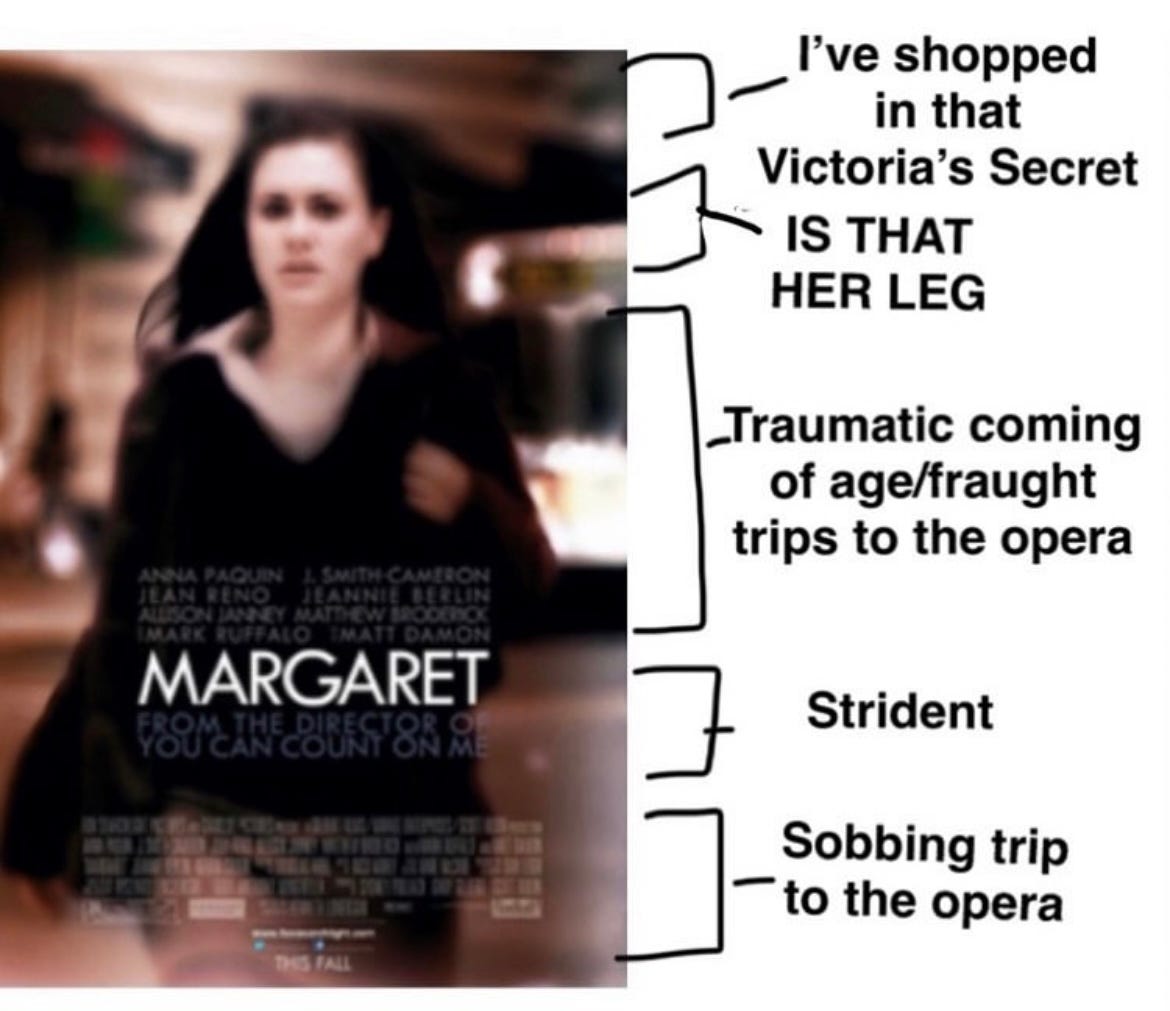
While The Hours holds tight on its central characters, Margaret is just as interested in the people on the periphery of its characters’ lives as it is on Lisa. What’s happening on a stage in Margaret, whether in Joan’s play or at the Metropolitan Opera, isn’t half as interesting as how it’s impacting the audience taking it in. Lonergan’s care for these audiences is Fosse-esque; someone lightly sways in their seat at the opera while everyone around them sits still, someone doesn’t laugh as everyone else does at a play, someone looks bored while the people around them are enraptured.
Even though Lisa - stricken with severe main character syndrome - is, objectively, the main character of this movie, Lonergan can’t help but remind you that she is not the main character of everyone else’s life. There are those people on the street, each interesting and alive as any main character when the camera pulls out just a bit. Little bites of the lives of those people (sometimes even people in the nearby apartments) around our characters are dropped in as ADR. There’s a scene in a diner where Lisa and her maybe-boyfriend aren’t even the focus until the camera moves in past the women eating at the table in front of them, whose conversation we hear fully and clearly up until Lisa’s bleeds into it.
Margaret asks us to reconcile whether observing tragedy is the same as having tragedy happen - viscerally, immediately, personally - to you. A stranger dying in your arms is traumatic, but what role do you have in the grief of her loved ones who have to live through the tragedy of losing her? Lisa wants to be the heroine of her own story, but she tries to make herself the heroine of everyone else’s, too. When she finally oversteps her bounds just an inch too far, Jeannie Berlin upbraids her spectacularly; finally, Lisa meets someone who isn’t moved by all of her searing emotion, who only reminds Lisa that everyone else around her is a person, just as much as her, and that this is real life, not an opera. I think I’m finally an adult because I no longer fear being yelled at like this, let alone romanticizing my life to the point of delusion like this.
Lisa spends the movie figuring out her own morality and where her moral compass fits in with the world’s, but her true moral crisis starts when Joan, her mother, advises her she shouldn’t go back to the police to change her statement to tell the truth of the bus driver running the red light. It’s the moment in every child’s life when they realize their parent is an imperfect human; Joan doesn’t give Lisa the advice she wants, and their relationship is fractured for most of the rest of the film. Lisa and Joan butt up against each other like Lady Bird and her mother - so similar that they can’t find ways to fit together. Lisa is self-involved in that immature, teenage way, but Joan is self-involved in the way only an actor can be, even making Lisa read her reviews to filter out anything negative. They get in a fight where they both call each other cunts; it’s painful but funny because, well, they are.
And then there’s the opera. Joan dates a man (Jean Reno) who loves to take her to the opera, even if she doesn’t quite understand it like he does. The emotional stakes in Margaret are operatic to the point that what every character has to express is so important to them that they can’t let each other finish their thoughts before interjecting. The director’s cut (this is the cut to watch, thank you so much) sits at just over three hours, and Emily, a major character, isn’t even introduced until the second hour. The emotional denouement - Lisa finally forgiving and reconnecting with her mother - happens in the orchestra section of the Met (while Renée Fleming and Susan Graham sing Tales of Hoffmann, natch). Lisa and her mother don’t love opera, but it’s to the credit of the patrons around them that two women weeping in each other’s arms in center orchestra is just another weeknight listening to Fleming and Graham. And frankly, if you have heard them live but have not wept in the house listening to one or both of them, you aren’t trustworthy.
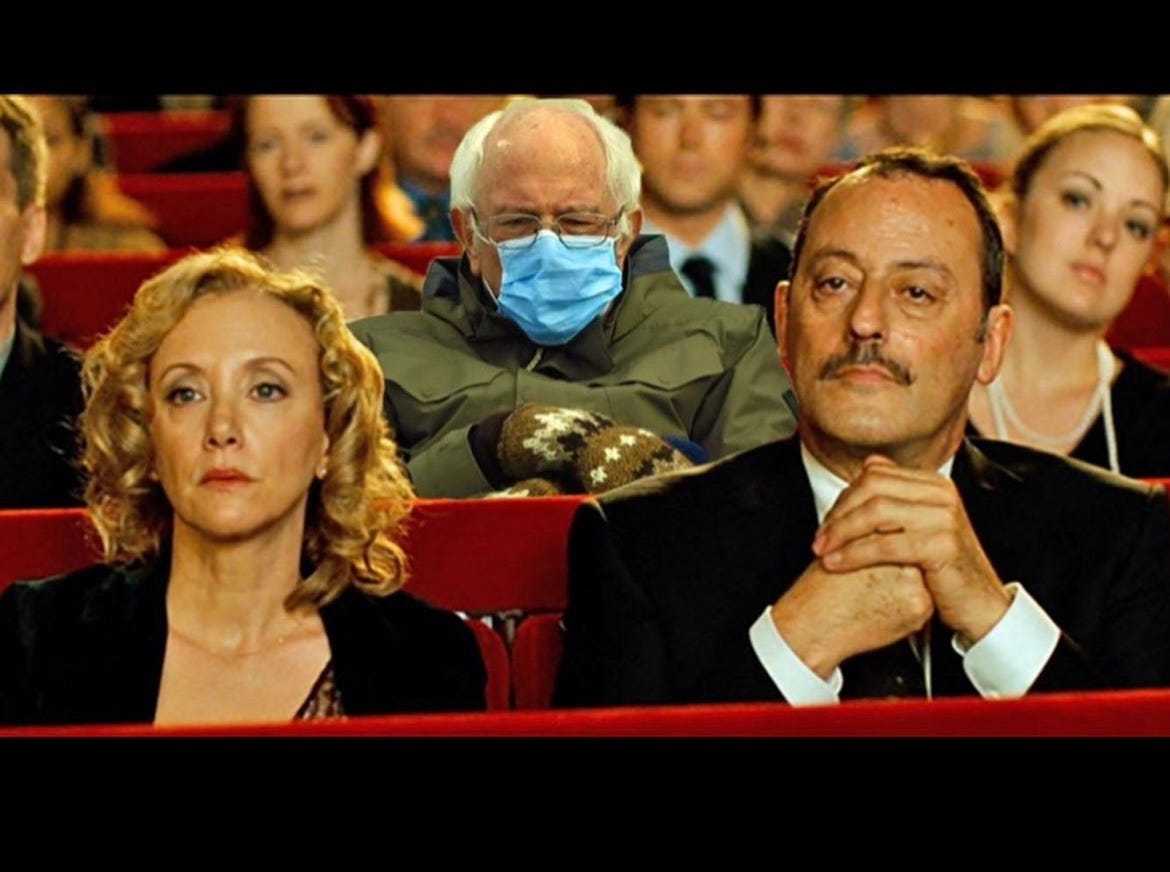
I fell in love with opera because I fell in love with Margaret. It’s a love affair that’s been waiting for me my whole life, after starting my musical life in a professional children’s chorus that performed alongside the Pittsburgh Symphony and Pittsburgh Opera (it still stings that I was too tall and too deep into puberty to play an alter boy in Tosca). It wasn’t necessarily Margaret that finally got me in a seat at the Met - more on what did in part three of this series - but something similar to Margaret kept me coming back. No other movie captures exactly what it feels like to sit in the dark in that barn of a house as the chandeliers rise, to be so awash with emotion and beauty and art that you have to cry. My favorite place to sit at opera is the boxes, peering down on the stage and orchestra. Maybe the sound balance isn’t the best, and you can’t see part of the stage (I watched Der Rosenkavalier without being able to see the bed at all), but it’s a vantage point where you can look back on the audience and down on the stage and the prompter’s box and sit with how you’re all there, in this moment, together. There’s nowhere else in the house where you can put your head in your hands and weep at Lise Davidsen, Samantha Hankey, and Erin Morley in that final Der Rosenkavalier trio or at Ailyn Pérez sprouting butterfly wings in Florencia en el Amazonas. Lisa running from the Met’s outdoor balcony overlooking Lincoln Center, down the stairs under the lobby chandeliers, and back to her orchestra seat with her mother before that big Renée Fleming/Susan Graham Baracolle duet, scored to the Lohengrin prelude, is as close to magic as I’ve ever felt watching a movie in my living room.
Taking in Margaret can be as frustrating as trying to explain it. It needs more than one watch. It jumps from the shocking and the violent (the cunt scene, Allison Janney dying like I’ve never, ever seen someone die onscreen) to the meandering and circuitous (all the classroom discussions that hide what the movie is about). It can feel winding and incomplete, but wouldn’t any movie that took years to be released after going through multiple studio and director edits (there’s even a Scorsese cut out there)? Yelling at people about Margaret feels like throwing my arms wide and yelling, “this is what it feels like to be me, this is who I am.” It’s the way I feel when I talk about musicals and opera and Beyoncé. I can analyze it and break it down (and we’ve all just sat through me doing that), but I can’t explain loving it for tangible reasons. The characters aren’t relatable. I don’t see myself in them. But do I see myself in Manon or Violetta? Do I have to find myself in art to go, “oh, this is what it can do?” It can’t all be The Hours, where I see myself in characters so much that I think about booking some therapy over it. If we’re lucky, though, sometimes the best of the art that shapes us comes together into something all at once tangible and inexplicable, where we see ourselves and the world beyond ourselves at once. Maybe it’s enough to cry in the dark as the music swells.
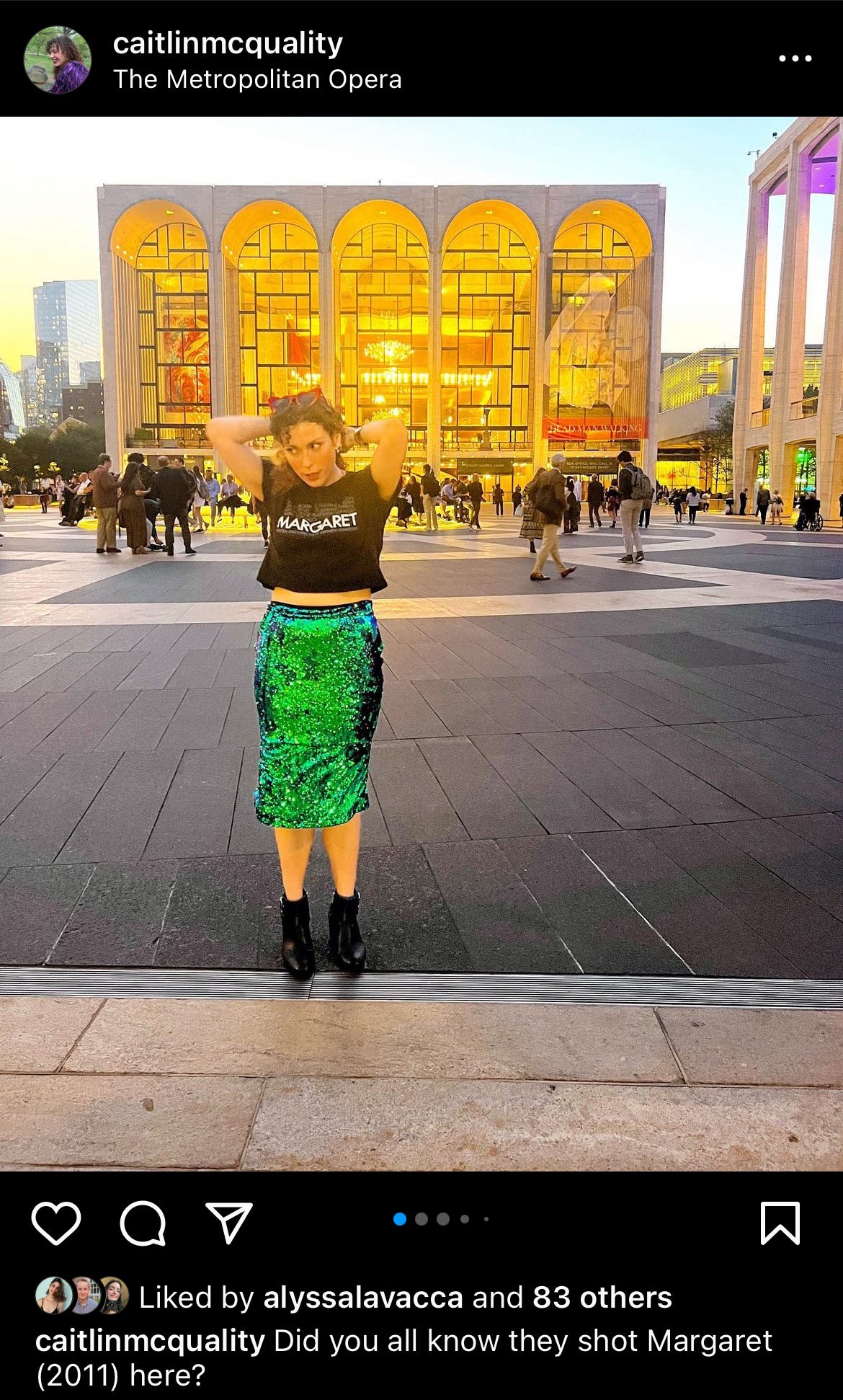
Thanks for making it this far, and tell a friend if you ALSO love Margaret (2011)!